By GrowsChat Team · August 1, 2026
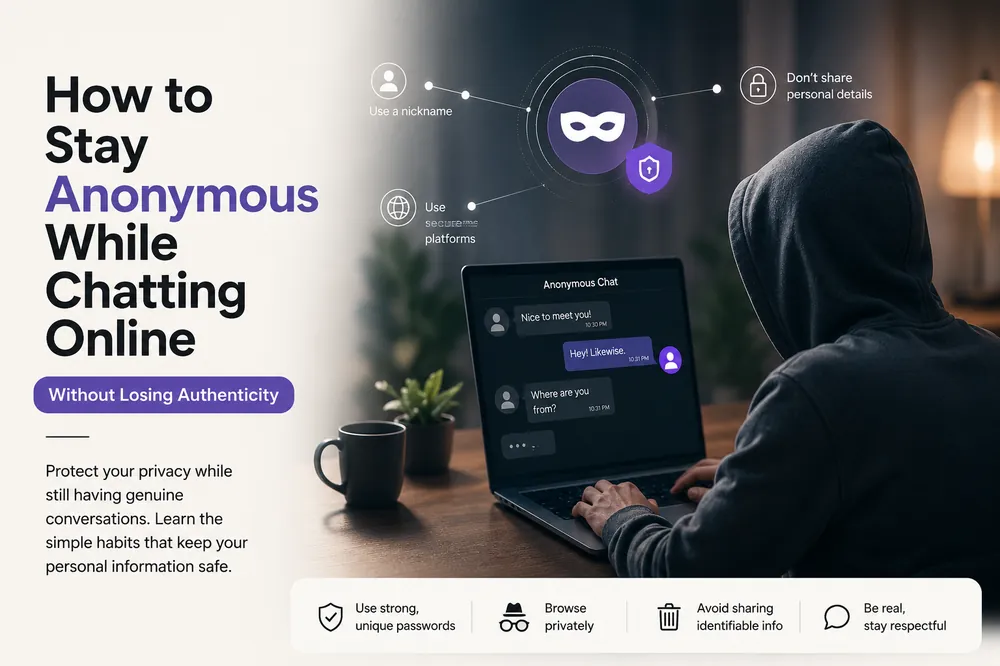
Many people want to chat with strangers online without revealing who they are. Sometimes it's to practice a language, sometimes it's to meet new people without social pressure, and sometimes it's simply because privacy feels increasingly valuable on today's internet.
Wanting to stay anonymous doesn't mean you have something to hide. In most cases, it simply means you want control over what personal information you share and when you share it. The internet makes it easy to connect with people across the world, but it also makes it surprisingly easy to reveal more about yourself than you intended.
The good news is that protecting your privacy doesn't require pretending to be someone else. You can have honest, meaningful conversations while keeping your real identity private. The key is understanding the difference between being anonymous and being inauthentic.
One of the biggest misconceptions about anonymous chatting is that it encourages people to create completely fake personalities. In reality, anonymity simply removes identifying information. You can still be genuine about your interests, opinions, hobbies, and experiences without sharing your full name, address, workplace, or social media accounts.
For example, saying you enjoy photography, hiking, or learning English tells someone about you without exposing personal details. On the other hand, sharing your hometown, daily routine, employer, or school may reveal more than you realize when combined together.
Authenticity comes from honesty, not from revealing every detail of your identity.
Most privacy mistakes happen gradually rather than all at once. People rarely introduce themselves by giving away sensitive information. Instead, they reveal small pieces throughout a conversation until someone could realistically identify them.
This might include:
Each piece may seem harmless individually, but together they create a surprisingly complete picture of your identity.
If you're unsure whether something is safe to share, ask yourself a simple question: Would I be comfortable if a complete stranger knew this information about me?
If the answer is no, it's better to keep the conversation more general.
A username gives you a consistent identity without exposing your real one. It also makes conversations feel more personal than remaining completely nameless.
Choose something that isn't connected to your other online accounts. Using the same username across multiple platforms makes it much easier for someone to find your profiles elsewhere.
Simple usernames based on hobbies, favorite books, animals, or random words are usually a better choice than usernames that include your real name or birth year.
If you're looking for more practical privacy habits, our guide on online privacy habits everyone should follow covers additional everyday practices that help protect your information.
Even if you never mention your name, photos can reveal far more than you expect.
A single image might include:
Video calls require even more awareness because your surroundings become visible in real time.
Before turning on your camera, consider what's visible behind you and whether it reveals anything about where you live or work. If you're using video chat platforms, it's worth reading our guide to video chat safety checklist before your next conversation.
It's common for someone you've just met to ask for Instagram, WhatsApp, Discord, or another social platform after only a few minutes of chatting.
There's nothing inherently wrong with continuing a conversation elsewhere, but moving too quickly often means exposing much more personal information than you intended. Many social profiles include your real name, photos, friends, location, and years of personal history.
Take your time before sharing accounts that connect directly to your offline identity. Genuine people generally respect boundaries and won't pressure you to reveal more than you're comfortable sharing.
Most conversations with strangers are perfectly normal, but occasionally someone may begin asking unusually personal questions very early.
Examples include repeatedly asking:
Healthy conversations develop naturally. If someone seems far more interested in collecting personal information than actually getting to know you, ending the conversation is often the safest choice.
Knowing how to spot fake profiles on random chat apps can also help you recognize suspicious behavior before it becomes a problem.
Some people worry that staying anonymous makes conversations feel shallow. In reality, meaningful conversations are built through shared experiences, curiosity, empathy, and mutual respect—not personal data.
People become friends because they enjoy talking with each other, laugh at the same jokes, support one another, or share similar interests. None of those require exchanging addresses or full identities on the first day.
Many long-lasting online friendships begin with anonymous conversations and naturally become more personal over time as trust develops. There's no need to rush that process.
If your goal is simply to meet interesting people, you might also enjoy reading how to make friends online safely, which explores how trust develops gradually in healthy online relationships.
Being anonymous shouldn't mean refusing to answer every question or making every conversation feel guarded. Instead, think of privacy as choosing which parts of yourself you want to share.
Talk about your interests.
Share your opinions.
Discuss your favorite movies, books, travel dreams, or hobbies.
Ask thoughtful questions.
Tell stories that don't expose sensitive personal details.
This approach allows conversations to feel genuine while still protecting the information that matters most.
In many cases, people appreciate authenticity far more than complete transparency.
Is anonymous chatting safe?
It can be, provided you avoid sharing sensitive personal information, use trusted platforms, and leave conversations that make you uncomfortable.
Can I make real friends while staying anonymous?
Yes. Many genuine friendships begin anonymously and become more personal only after trust develops naturally over time.
Should I use my real name when chatting online?
Not necessarily. Using a nickname or username is a common and effective way to protect your privacy while still participating in conversations.
What personal information should I avoid sharing?
Avoid sharing your full name, address, phone number, workplace, school, financial information, passwords, and anything that could identify your location or daily routine.
When is it okay to share more personal information?
Only after you've built trust over time and genuinely feel comfortable doing so. Even then, sharing information gradually is usually the safest approach.
Staying anonymous online isn't about hiding who you are—it's about deciding what parts of your identity deserve to remain private until trust has been earned. You don't need to invent a fake personality or avoid meaningful conversations to stay safe.
The best online conversations happen when people are honest about themselves while respecting their own boundaries. By sharing your interests instead of your identity, thinking carefully before revealing personal details, and trusting your instincts when something feels wrong, you can enjoy authentic conversations without giving up your privacy.