By GrowsChat Team · August 4, 2026
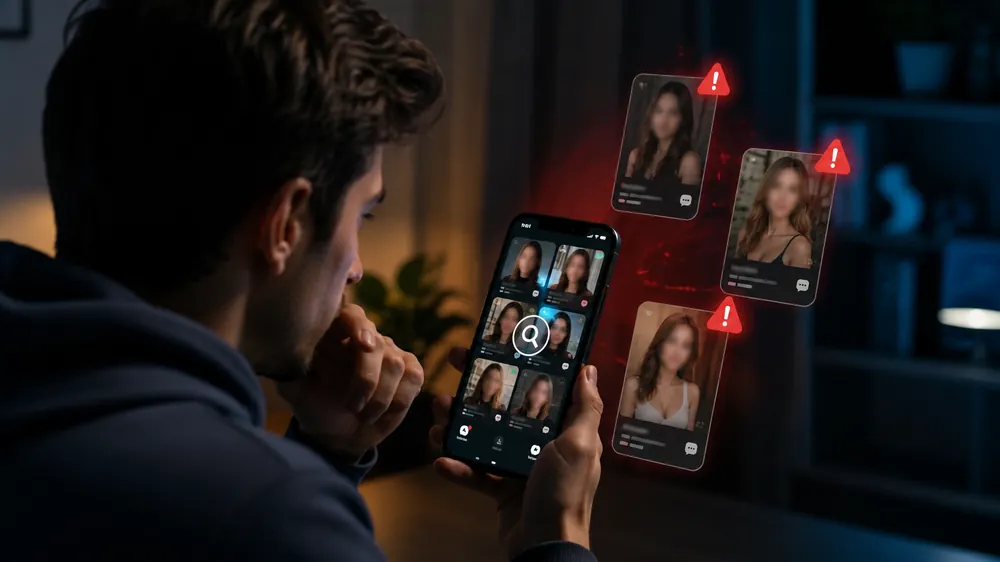
Not every strange conversation online is a fake profile, sometimes it's just an awkward stranger. But a real subset of accounts on any chat platform aren't who they claim to be, scam operations, bot accounts, or people using a fabricated identity for reasons that range from harmless to genuinely harmful. Learning to spot the pattern early saves time and, in the more serious cases, protects you from something worse than a wasted conversation.
It helps to understand the motive, because the motive shapes the pattern. Most fake accounts fall into a few broad categories: scam operations working from a script designed to build trust quickly and extract money, bot accounts designed to farm engagement or push links, and individuals misrepresenting themselves for personal reasons that aren't necessarily criminal but are still dishonest, using old photos, a fake age, or an invented backstory.
The scam category is the one worth the most caution, because it's often organized, practiced, and specifically designed to bypass normal skepticism through speed and emotional pressure. The patterns below apply most directly there, though several of them overlap with the other categories too.
One of the most consistent signs of a scripted, scam-oriented profile is a conversation that escalates emotionally much faster than a real, organic connection typically would. Declarations of strong feelings within the first few conversations, pressure to move off the platform to a private messaging app almost immediately, or a sense that the other person is working from a checklist rather than actually responding to what you're saying, are all worth noticing.
Real connections, even fast-moving ones, still tend to feel responsive, specific reactions to things you've actually said, not generic warmth that would apply to literally anyone on the other end. If a conversation feels like it could be happening with a hundred other people simultaneously with barely any changes, that's a meaningful signal.
A few concrete things worth checking, none of them foolproof alone, but meaningful together. Does the person avoid a live video call or voice call, repeatedly, with vague excuses. Do their photos look unusually polished, professional, or inconsistent with the rest of what they describe about their life. Does their story shift slightly in ways that don't quite add up, a detail from an earlier conversation that contradicts something said later.
None of these individually proves anything, people have genuine reasons to avoid video calls sometimes, and memory of small details is imperfect even in real conversations. But a cluster of these signs together is worth taking seriously rather than explaining away.
This is the clearest and most serious red flag of all, and it's worth treating as close to a hard rule. Any request for money, gift cards, cryptocurrency, or financial details, regardless of how sympathetic or urgent the reason given sounds, medical emergency, travel funds, a stuck shipment, is a defining feature of a scam account. Genuine connections built over a short period essentially never involve a real financial request this early, and the emotional urgency attached to these requests is itself part of the manipulation, designed to make you act before you think it through.
If this comes up at any point, the conversation has told you what you need to know.
Fake or bot-driven accounts often lean on flattery that could apply to literally anyone, generic compliments about your appearance or personality delivered early and often, without much connection to anything specific you've actually said. Genuine conversation tends to notice particulars, a real interest you mentioned, an actual opinion you shared, rather than broad, interchangeable praise.
This is subtler than the financial red flag, but it's a useful early signal, since it often shows up well before anything more serious does.
Beyond any specific checklist, it's worth taking seriously the vague, hard-to-articulate feeling that a conversation doesn't add up, even without being able to point to one clear reason. This instinct is often picking up on small inconsistencies, timing, tone, pacing, that are hard to name individually but register collectively. Ending a conversation because something feels off costs nothing, and it's a completely reasonable response even without concrete proof.
For a broader look at staying safe in online conversations generally, not just around fake profiles specifically, see how to make friends online safely and naturally, which covers what reasonable caution looks like as a connection develops over time, and what to watch for if someone pushes past a boundary you've set.
Some of the responsibility here sits with the platform itself, not just the individual user, and it's worth knowing what to expect from a platform that takes this seriously. A clear, accessible way to report and block a suspicious account mid-conversation. Some visible moderation presence rather than a policy that exists only in a terms of service page nobody reads. And ideally, systems in the background working to catch bot activity and repeat-offender patterns before they reach very many real users at all. This is covered in more depth in how to choose the right random chat platform, where moderation quality is treated as the single factor that matters most, ahead of features or design.
GrowsChat is built with clear in-chat reporting and blocking for exactly this reason, so a suspicious account is never more than one tap away from being flagged and removed from your conversation, without needing to dig through settings to find the option.
What's the single biggest red flag for a fake profile? Any request for money, gift cards, or financial information. This is close to a universal marker of a scam account, regardless of how sympathetic the story attached to it sounds.
Is refusing a video call always a sign someone is fake? Not always, some people have genuine reasons to avoid video early on. But repeated, vague excuses combined with other warning signs, like fast emotional escalation or generic compliments, are worth taking more seriously together than any one sign alone.
Why do fake profiles often move conversations to another app quickly? Moving to a private messaging app removes the original platform's moderation and reporting tools, which makes it easier for a scam or bot account to continue operating without being flagged or blocked.
What should I do if I suspect I'm talking to a fake profile? Stop sharing any personal or financial information, and use the platform's reporting or blocking tools right away. There's no need to confront the account or seek proof first, trusting the pattern is enough.
Can bots pass as real people in text conversation? Increasingly, yes, at least for a few exchanges. Repetitive phrasing, generic responses that don't track specific details you've mentioned, and oddly fast response times are common signs worth watching for.
Spotting a fake profile usually comes down to noticing a pattern rather than one single red flag, unusually fast emotional escalation, generic compliments, inconsistencies between what someone says and what they show, and above all, any request for money. None of these prove anything in isolation, but together they're a reliable signal worth trusting. Combined with a platform that actually makes reporting and blocking easy, that pattern recognition is most of what keeps a random chat experience safe.