By GrowsChat Team · June 17, 2026
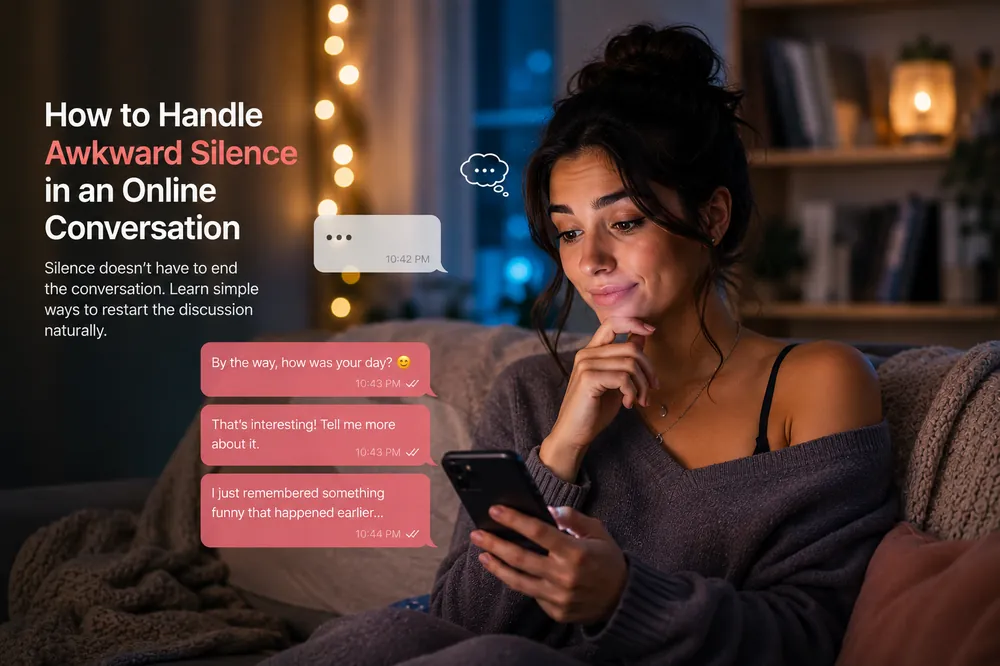
Every online conversation eventually hits a pause where neither person says anything for a moment. In person, this barely registers, a brief lull that passes without either person thinking twice about it. Online, that same pause can feel much heavier, sitting there visibly, inviting the thought that the conversation has died and it's somehow your job to save it.
The good news is that awkward silence is rarely as fatal as it feels in the moment, and there are a few simple, low-effort ways to move past it without forcing anything.
A pause in a live conversation has a natural shape, it starts, it ends, and the conversation continues. Online, a pause has no such shape. There's no way to tell if the other person is thinking, distracted, typing a long reply, or has simply stepped away. That ambiguity is what makes online silence feel so much more loaded than a normal pause in speech, as covered in how social anxiety changes online communication, where response delays specifically tend to get filled in with worst-case assumptions rather than neutral ones.
Recognizing this pattern for what it is, an ambiguous gap rather than a verdict on the conversation, is often enough on its own to make the silence feel less urgent to fix.
The instinct when a conversation goes quiet is often to throw in literally anything just to break the silence, "haha so..." or a string of question marks. This usually makes things feel more awkward, not less, because it signals panic rather than natural conversation. A short pause doesn't need to be treated as an emergency. Waiting a moment before responding is completely normal, and often the other person is doing exactly the same thing on their end.
One of the easiest ways to restart a stalled conversation is to loop back to something mentioned earlier that never got fully explored. If they mentioned a hobby, a trip, or an opinion in passing, picking that thread back up, "wait, you mentioned you used to do X, tell me more about that" works well because it doesn't require inventing a new topic from nothing. It also signals, correctly, that you were paying attention the first time, which tends to land better than a completely fresh question would.
This overlaps a lot with actually following up on what someone says in the first place, something covered in more detail in how to talk to a stranger online, where responding to specifics rather than jumping topics is one of the biggest levers for keeping a conversation alive before it even reaches an awkward pause.
If there's really nothing left to loop back to, shifting to a different type of question can reset the energy. Instead of another factual question, try an opinion-based one, "what's something you've changed your mind about recently" or "what's a small thing that made your week better." These tend to produce more interesting, less effortful answers than another round of factual back and forth, and they often reveal something that opens up a completely new direction for the conversation.
It might seem counterintuitive, but simply acknowledging the pause out loud is often the fastest way to dissolve it. Something like "okay I'm blanking, what's something you're into lately" is honest, low pressure, and usually gets a warm response, since it removes the pretense that everything is smoothly ongoing when it clearly isn't. Most people appreciate the directness more than a forced, overly smooth transition, and it hands the conversational effort back over evenly instead of leaving it all on you.
Not every silence needs to be rescued. Some conversations have simply run their natural course, and trying to force new life into one that's genuinely finished usually just produces more awkwardness, not less. If a silence follows what already felt like a complete, satisfying exchange, that's often a good moment to close things out gracefully rather than manufacturing a new topic purely to avoid the pause, in the way described in how to end an online conversation politely, where a clear, warm goodbye is almost always a better outcome than dragging a finished conversation further than it wants to go.
Is awkward silence a sign the conversation is going badly? Not usually. It's more often just an ambiguous pause than a signal that something has gone wrong, and reading too much into it tends to create more anxiety than the silence itself warrants.
What's the fastest way to restart a stalled conversation? Looping back to something mentioned earlier in the conversation tends to work better than inventing a completely new topic, since it doesn't require starting from nothing.
Should I just say something to fill every pause? Not necessarily. A brief pause is normal, and rushing to fill every single one can come across as more anxious than natural. It's fine to let a short pause exist without immediately reacting to it.
Is it okay to point out that the conversation feels awkward? Yes, done lightly. Naming it directly and simply is usually better received than trying to smooth over an obvious lull with forced enthusiasm.
How do I know if a silence means the conversation is actually over? If the silence follows a conversation that already felt complete, it's often a natural ending rather than something to push past. Closing gracefully at that point usually works better than manufacturing a new topic just to keep going.
Awkward silence online feels bigger than it actually is, mostly because the ambiguity of a text pause invites worse assumptions than a spoken pause ever would. Looping back to an earlier topic, shifting to a more open question, or simply naming the pause out loud all work better than panicking to fill the gap with anything at all. And sometimes, the right move isn't to rescue the silence, it's to recognize the conversation has already said what it needed to and let it end well.