By GrowsChat Team · July 2, 2026
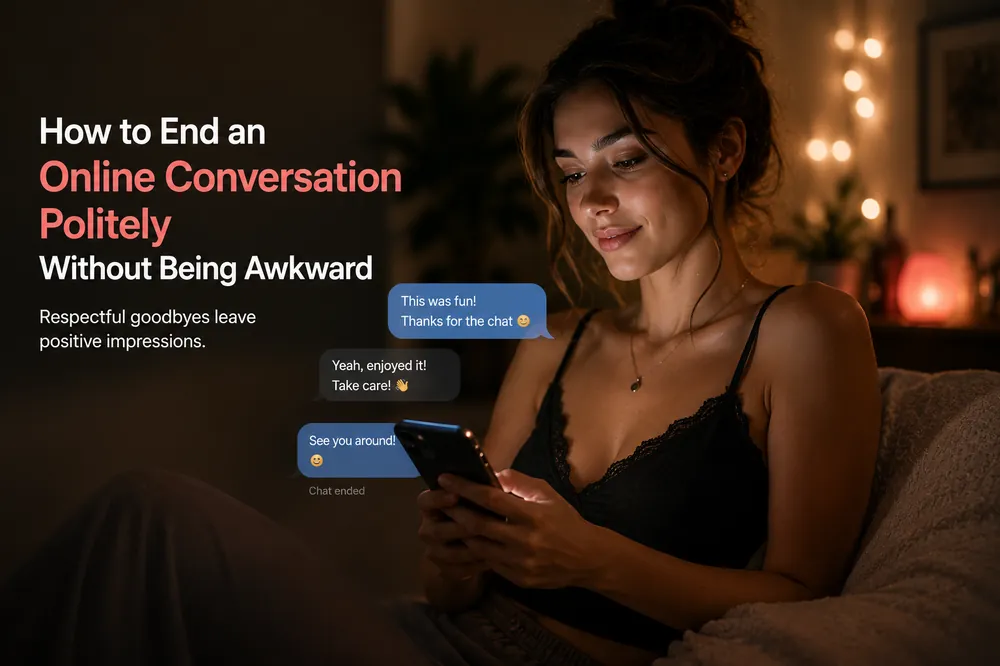
Most advice about online conversation focuses on how to start one. Almost nobody talks about how to end one well, even though a badly handled exit can leave a worse impression than an awkward opener ever could. Trailing off into silence, ghosting mid-sentence, or fumbling through three separate goodbyes before actually leaving all have the same effect: they make a perfectly fine conversation end on an uncertain note.
Ending well is a skill of its own, and it's a much smaller one than people expect. Here's how to do it without it feeling clumsy.
Starting a conversation has a clear script, a greeting, a question, something to react to, an approach covered in more depth in how to approach strangers online. Ending one doesn't have the same built-in structure, which is part of why it feels harder even though it should logically be easier. There's also a specific worry that shows up here: the fear that ending the conversation will be read as rejection, that saying "I should go" means the other person will feel dismissed or unwanted.
In reality, most people are perfectly used to conversations ending. A conversation that ends cleanly, with a clear and warm sign-off, rarely reads as rejection. What tends to read badly is the opposite, a conversation that just stops, with no signal at all, leaving the other person unsure whether you're still there, distracted, or gone for good.
The single most common mistake is trailing off instead of actually saying goodbye. A conversation that goes quiet with no explanation leaves the other person guessing, and guessing is uncomfortable. Did they say something wrong. Did you lose interest. Are you just busy. None of these questions need to exist if you simply say you're heading out.
A short, direct line does far more work than people expect. Something as simple as "I've gotta run, this was nice" closes the loop cleanly and doesn't leave anything hanging. It doesn't need justification or a long explanation, a brief, warm sentence is enough on its own.
There's a temptation to over-explain why you're leaving, work, tiredness, another commitment, as if leaving without a reason would seem rude. In most cases it wouldn't. A simple "heading out, take care" is complete on its own. A reason can be added if it's genuinely easy and true, but it's not a requirement for a polite exit, and reaching for an elaborate excuse usually makes the goodbye feel more effortful and less natural than it needs to be.
How you end a conversation should roughly match how it went. A short, casual exchange can end with something equally short and casual, "nice talking, take care." A longer, warmer conversation deserves a slightly warmer close, something that acknowledges the conversation itself, "really enjoyed this, hope the rest of your day goes well."
The mismatch to avoid is ending a genuinely good conversation with something too abrupt, which can feel like a sudden temperature drop, or padding a short, casual chat with an overly long goodbye that doesn't match the energy that came before it.
Not every conversation needs an elaborate exit. If a conversation never really got going, stayed short and low energy the whole way through, a brief, polite close is completely appropriate and doesn't need to be softened further. Something like "good talking, take care" works fine even for a conversation that didn't have much to it. There's no obligation to manufacture warmth that wasn't actually there, forcing it usually feels more awkward than just closing cleanly. This is especially true on a platform built around quick, spontaneous matches, if a chat on GrowsChat never quite clicks, there's no cost to closing it out politely and starting a fresh match right after.
Having one or two go-to lines ready removes a surprising amount of the awkwardness, the same way having a couple of opener lines ready makes starting easier. A few that work in most situations:
None of these need to be memorized exactly. The point is having the general shape ready, acknowledge the conversation briefly, state that you're leaving, close warmly, so you're not building a goodbye from scratch in the moment.
Sometimes a goodbye message gets no reply, the other person has simply moved on or stepped away without saying so. This isn't something to read into. It's one of the most common and least meaningful things that happens in online conversation, and it says nothing in particular about how the conversation went, similar to the kind of ambiguity covered in how to handle awkward silence in an online conversation. Sending a goodbye and moving on, whether or not you get a reply to it, is a complete and polite exit on your end regardless of what happens after.
Is it rude to end a conversation without explaining why? No. A brief, warm goodbye is complete on its own. A reason can be added if it's easy and genuine, but it's not required for the exit to feel polite.
What should I do if I don't know how to end a conversation naturally? Having one or two simple exit lines ready in advance removes most of the difficulty, since you're not inventing a goodbye from scratch in the moment.
Is it better to end a conversation abruptly or let it trail off? A clear, direct goodbye is almost always better than trailing off. Trailing off tends to leave the other person uncertain, while a stated goodbye closes things cleanly.
What if the other person doesn't respond to my goodbye message? That's common and rarely meaningful. It doesn't require a follow-up or any particular interpretation, it just means the conversation has ended on both sides.
Should every conversation end with a warm, detailed goodbye? No. The goodbye should roughly match the tone of the conversation. A short, casual exchange is fine ending with something equally brief.
Ending a conversation well is a much smaller skill than it feels like in the moment, mostly just saying clearly that you're leaving, keeping the tone consistent with how the conversation actually went, and not treating silence afterward as something to interpret. A clean, warm exit leaves a better impression than people expect, and it's a lot easier to pull off than the anxious version of it usually suggests. And since starting a new conversation is always just one tap away, there's no real pressure to make any single goodbye perfect.